Google is making one of the biggest operational changes to Local Services Ads since the platform launched. Local Services Ads are moving into Google Ads through a new Performance Max for Pay-per-Lead campaign type, giving contractors and home service businesses one place to manage campaigns, leads, messaging, and reporting.
Billing and account access already run through Google Ads, so that part is not changing. What is moving is the day-to-day operational side of Local Services Ads, which currently lives in a separate LSA dashboard.
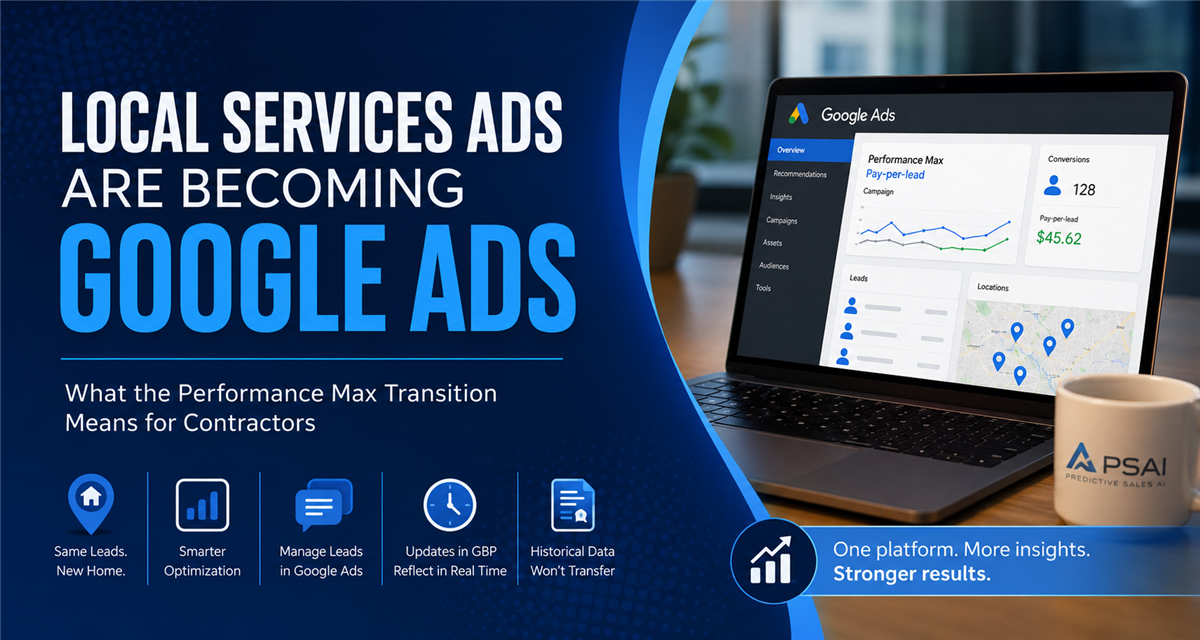
For contractors, the transition should simplify management without requiring campaigns to be rebuilt.
Here is what you need to know.
What Is Changing?
Local Services Ads will no longer operate through a separate management dashboard. Instead, the operational side of the program will move into Google Ads.
That includes:
Campaign management
Lead management
Customer messaging
Reporting
Campaign updates
Advertisers will use a new Performance Max campaign with Pay-per-Lead bidding, while ads will continue appearing across Google Search and Google Maps.
Businesses will also continue paying for qualified leads rather than clicks, preserving the core Local Services Ads billing model.
What Is Not Changing?
Although the interface is changing, several important parts of the program will remain the same.
Billing will continue through Google Ads.
Existing Google Ads account access will remain in place.
Businesses will continue paying for qualified leads.
Ads will continue appearing on Search and Maps.
Service-area targeting will remain available.
The current lead qualification model will remain largely intact.
Google Guaranteed eligibility will continue to apply to qualified businesses.
For homeowners, the experience of finding and contacting a contractor through Google should remain largely unchanged.
You Will Not Need to Rebuild Your Campaign
Google is handling the migration automatically.
Everything currently configured in your Local Services Ads account will carry over into Google Ads, including:
Campaign budgets
Service areas
Service types
Ad schedules
Existing account settings
Contractors should not need to recreate campaigns, rebuild targeting, or manually transfer their core account configuration.
That should make the transition less disruptive than many other major Google Ads changes.
Why Google Is Making the Change
Local advertising has historically been split across several different Google platforms.
Contractors often manage:
Traditional Google Ads campaigns
Local Services Ads
Google Business Profile information
Lead messaging
Campaign reporting
Bringing the operational side of Local Services Ads into Google Ads creates a more centralized system for managing paid advertising.
The primary benefit is not a change to billing. It is the ability to manage campaigns, leads, customer messages, and reporting from one platform instead of moving between separate dashboards.
Day-to-Day Management Should Become Easier
Once an account is migrated into Google Ads, advertisers should have more control over routine account updates.
For example, businesses should be able to update certain campaign details, such as a phone number, directly within Google Ads instead of relying on a separate Local Services Ads workflow.
Business information will also become more closely connected to the company’s Google Business Profile.
Information such as the following should automatically pull from the Google Business Profile:
Business name
Address
Business hours
Other core business details
This reduces the need to maintain the same information in multiple places. Contractors will be able to update their Google Business Profile and have those changes reflected within their advertising setup.
How You Will Know the Migration Is Coming
Google plans to notify advertisers before their account is moved.
Approximately 14 days before the scheduled migration date, advertisers should receive:
An email notification explaining the upcoming change
A banner inside the current Local Services Ads dashboard
Once the migration date arrives, the existing Local Services Ads dashboard link will redirect advertisers into Google Ads.
There should not be a period where contractors need to manage both versions of the campaign separately.
What Will Change After the Transition?
1. Performance Max Will Play a Larger Role
Performance Max is becoming a larger part of Google’s advertising ecosystem.
As Local Services Ads move into Google Ads, businesses will become more dependent on Google’s automated systems for:
Budget allocation
Lead optimization
Audience matching
Bid management
Campaign delivery
This makes accurate business information, clean customer data, and reliable conversion signals increasingly important.
2. Historical LSA Reporting Will Not Transfer
One of the most important items for advertisers to understand is that historical Local Services Ads reporting will not migrate into Google Ads.
Once the old dashboard is no longer available, businesses may lose access to historical reports stored there.
Contractors that rely on historical lead volume, cost-per-lead trends, dispute data, or long-term campaign performance should export those reports before their scheduled migration date.
3. Google Business Profile Accuracy Becomes More Important
As more business information flows directly from Google Business Profile into advertising campaigns, keeping that profile accurate becomes even more important.
Contractors should regularly review:
Business name
Address
Phone number
Business hours
Primary and secondary categories
Services
Service areas
Photos
Reviews
Incorrect or outdated profile information may now affect more than local visibility. It may also flow directly into paid campaign management.
What This Means for Roofing and Home Service Companies
The migration should make Local Services Ads easier to manage, but it also reinforces a larger shift taking place across Google advertising.
Campaign success increasingly depends on more than simply setting a budget and selecting a service area.
Contractors need:
Accurate business information
Strong Google Business Profiles
Reliable conversion tracking
Clean customer and lead data
Fast lead response
Consistent review generation
Connected CRM and marketing systems
Google is simplifying the advertising interface, but contractors still need the right infrastructure behind the campaign to turn leads into revenue.
Where Predictive Sales AI Adds Value
The transition does not eliminate the need for strong marketing systems. It increases the importance of what happens before and after Google generates the lead.
Predictive Sales AI helps contractors organize customer data, strengthen lead management, improve follow-up, and generate opportunities beyond Google Ads alone.
Turn Better Data Into Better Advertising
As Google relies more heavily on automation, the quality of the data connected to each campaign becomes more important.
Predictive Sales AI helps contractors strengthen that data through:
Verified homeowner information
First-party audience data
Property intelligence
AI audience targeting
Historical customer insights
CRM integrations
Cleaner customer data and more complete lead outcomes can help create stronger signals for future campaign optimization.
Maximize Every Lead
A simpler Google Ads dashboard does not automatically improve conversion rates.
Contractors still need to respond quickly, prioritize the right opportunities, and consistently follow up with homeowners.
Predictive Sales AI helps businesses:
Route leads into their CRM
Automate follow-up
Identify high-priority opportunities
Prioritize homeowners using predictive insights
Reduce lead response time
Track what happens after the lead is generated
Improving conversion from existing lead volume can often produce a greater return than simply increasing advertising spend.
Build Marketing Beyond Paid Search
Google Ads remain an important source of contractor leads, but they should not be the only source.
Predictive Sales AI helps businesses generate additional opportunities through:
AI Audience Targeting
Project Showcase referral marketing
Weather-triggered campaigns
Warranty notifications
Customer remarketing
Automated review generation
Website visitor identification
Local neighborhood marketing
The result is a more diversified lead-generation strategy that does not rely exclusively on Google’s advertising platform.
What Contractors Should Do Now
Google will handle the technical migration, but contractors should still take several steps before their account moves.
Export historical Local Services Ads reports. These reports will not transfer into Google Ads.
Review your Google Business Profile. Confirm that your name, address, phone number, hours, services, and service areas are accurate.
Watch for Google’s migration notice. Expect an email and an in-platform banner approximately 14 days before the change.
Verify your current campaign settings. Review budgets, service types, service areas, and schedules before they are carried over.
Confirm conversion tracking and CRM integrations. Make sure lead outcomes are being captured accurately.
Review your lead-response process. Faster and more consistent follow-up will remain critical regardless of where the campaign is managed.
There is nothing to rebuild, but this is still a good opportunity to audit the systems and information supporting your campaigns.
Final Thoughts
Google’s decision to move Local Services Ads into Google Ads is primarily a management and operational change.
Billing and account access already run through Google Ads. The real shift is that campaign settings, leads, messaging, reporting, and routine updates will now be managed in the same place.
For contractors, that should mean fewer dashboards, easier account updates, and a more direct connection between Google Ads and Google Business Profile.
Google will handle the migration automatically, but businesses should still export historical reports, verify their account settings, and review their Google Business Profile before the transition takes place.
For companies using Predictive Sales AI, the change reinforces the value of having connected customer data, strong lead-management systems, fast follow-up, and diversified marketing programs working alongside Google Ads.
Tags

WordPress Security Vulnerabilities Highlight Why Your Website Platform Matters
Do Call Tracking Numbers Hurt SEO?
How Contractors Use Project Showcase to Turn Completed Jobs into New Opportunities

How Mr. Roofing Turned Decades of Customer Trust into Smarter Marketing and 38% Growth
Meet the Next Evolution of PSAI: From AI Assistance to AI-Powered Action
Subscribe to Predictive Sales AI, LLC's Blog

Comments